


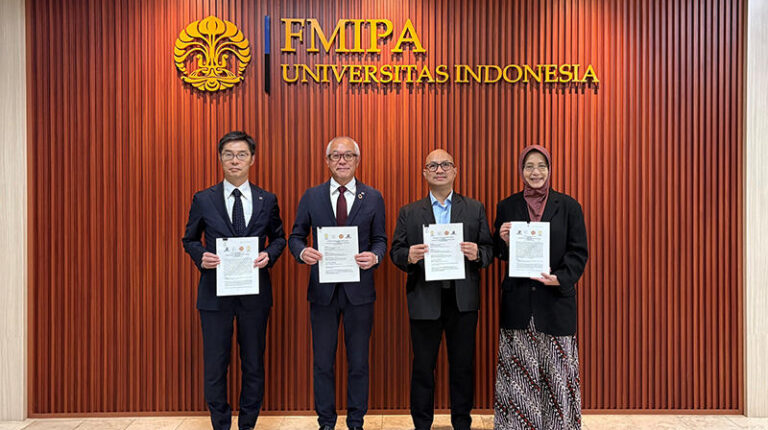
Bridgestone Corporation has launched a joint research project with Universitas Indonesia, Public University Corporation Yokohama City University (Yokohama City University) and Public University Corporation Maebashi Institute of Technology (Maebashi Institute of Technology) for the genetic analysis of para rubber trees. This collaboration will leverage trees and genetic information from Bridgestone’s natural rubber farm in Indonesia.
The joint project aims to create a marker-assisted selection technology that enables early identification of elite trees (high-yielding, stable performers). Through this effort, Bridgestone and the partner universities seek to contribute to improvements in the productivity and stable supply of natural rubber.
Masashi Otsuki, executive director, Institute of Advanced Technology, Bridgestone Corporation, said, “By co-creating with stakeholders across the natural rubber industry and promoting the sustainable use of natural rubber, Bridgestone strives to achieve the corporate commitment of ‘Ecology: Committed to advancing sustainable tire technologies and solutions that preserve the environment for future generations’ described in its Bridgestone E8 Commitment.”
Stable yet sustainable
While natural rubber is a renewable resource, its source, the para rubber tree, grows only in geographically limited regions near the equator and is susceptible to external factors such as climate change and disease.
As global vehicle ownership grows and demand for natural rubber increases, a key challenge is ensuring a sustainable and stable supply without expanding farmland in ways that risk deforestation. To address this, Bridgestone is developing technologies to improve rubber productivity, including disease diagnostics and data-driven planting optimization on existing farmland. The company also supports smallholder farmers by deploying these tools and providing training based on expertise from its own farms. These efforts aim to increase productivity, improve livelihoods and enhance the long-term sustainability of natural rubber production.
In this joint research, Bridgestone will provide latex samples from individual para rubber trees on its farm, along with genetic data held by the company. Universitas Indonesia will generate DNA and RNA data, while Yokohama City University and Maebashi Institute of Technology will analyse the genetics to identify genes linked to rubber productivity.
Based on these findings, the partners aim to develop marker-assisted selection technology to enable faster, more precise identification of high-performing trees, significantly reducing breeding timelines that traditionally take decades.
Following validation and the development of propagation and nursery systems, Bridgestone plans to gradually replace existing trees with elite varieties over the medium to long term, improving productivity and stabilizing yields within limited land resources.
Prof. Dr Tito Latif Indra, M.Si, dean of the faculty of mathematics and natural sciences, Universitas Indonesia, said, “This collaboration is such an important foundation in strengthening FMIPA UI’s academic contribution in impactful global research. Through research in the field of sustainable natural resources, we are trying our best to reinforce the ecosystem of global natural rubber production and provide significant innovation to support sustainable rubber plantations in Indonesia.”
Yukihisa Shimada, director, Kihara Institute for Biological Research, Public University Corporation Yokohama City University, added, “Through international collaboration, we will drive high-precision genome analysis and the selection of promising lines, contributing to the creation of scientific knowledge for sustainable resource use.”
Kensuke Nakamura, president, Public University Corporation Maebashi Institute of Technology, commented, “As a public university, we are dedicated to fostering both locally grounded research and international research partnerships. By leveraging these strengths, we seek to generate impactful knowledge that will contribute to building a more sustainable society.”
Related news, Conti celebrates two decades of tire production in Camaçari, Brazil