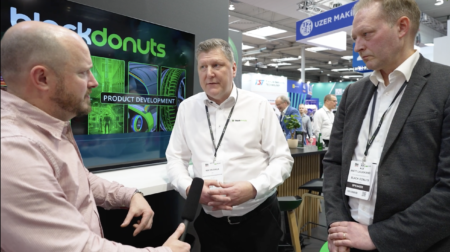



TTI speaks with Dr Antti Laukkanen, CTO of the Nemus business unit at Black Donuts, about his upcoming presentation at Tire Technology Expo Conference 2026, which will take place at the Deutsche Messe in Hannover, Germany, March 3-5
Dr Laukkanen and Black Donuts colleague Ilkka Lehtoranta, head of tire and material development, will give a presentation titled ‘Replacing carbon black and other fossil-based components with microfibrillated cellulose – a novel premix material for the tire industry’, on Day 2 of the conference.
Laukkanen has over two decades of experience in the field of industrial R&D in biomaterials, especially in cellulose nanomaterials and complex polymer systems. He is an experienced leader in product development, innovation and process scale-ups of novel bio-based materials and is currently leading the technology development within the new Nemus business unit at Black Donuts.
Can you summarize the topic of your conference presentation?
My session introduces Nemus, a novel premix technology that enables the integration of microfibrillated cellulose (MFC) – a renewable, plant-based reinforcement material – into tire manufacturing. While MFC has been widely used in paper and board applications, its adoption in tires has been limited due to compatibility issues between hydrophilic cellulose and hydrophobic rubber. Nemus solves this challenge through a wet compounding process, creating a premix of natural rubber and MFC that is easy to use in existing tire production workflows while delivering strong technical performance.
What do you hope attendees will take away from your presentation?
I hope they will recognize the environmental and performance benefits of replacing fossil-based components such as carbon black with renewable alternatives, and understand how Nemus offers a proactive approach to tightening regulatory space.
I also hope they’ll understand how Nemus technology overcomes long-standing material compatibility challenges through innovative processing. I’d also like them to appreciate the potential for Nemus to transform tire sustainability without compromising efficiency or quality, and learn about the performance potential Nemus may offer for compounds and tire characteristics.
What are the challenges with applying MFC to the tire industry?
The main challenges include material incompatibility: MFC is hydrophilic, while rubber is hydrophobic, making direct mixing difficult. Another is dispersion and bonding: achieving uniform dispersion and strong interfacial adhesion is critical for performance. Also, consideration must be given to process integration: any solution must fit seamlessly into existing tire manufacturing processes to be viable at scale. Nemus addresses these issues through its premix approach. Finally, economics: so far, cellulose microfibrils have been too expensive for large-scale replacement of fossil-based ingredients.
How important is it to enable such new materials to be integrated into the tire manufacturing process?
It’s crucial. Developing a sustainable material is only half the challenge; the real breakthrough comes from process innovation that ensures compatibility with existing equipment and workflows; performance and cost-efficiency at industrial scale; non-compromised properties, even enhanced tire performance with Nemus; reliability; and scalability for global production.
How big an impact do you think MFC could have on tire production if it can be successfully industrialized?
The impact could be game-changing. There will be environmental benefits, including reduced reliance on fossil-based fillers, lowered carbon footprint. Benefits in material diversification will include less dependence on carbon black and other non-renewable components. And there is also performance potential: early results indicate strong reinforcement properties and durability. If Nemus is scaled successfully, it could become a cornerstone of next-generation sustainable tires.
What’s next for Nemus?
Next steps include scaling up production to meet industrial demand, collaborations with tire manufacturers for commercial integration; and continuous optimization of the wet compounding process for cost and efficiency.
The ultimate goal is to move from pilot projects to full-scale industrial adoption in the near future.
‘Replacing carbon black and other fossil-based components with microfibrillated cellulose – a novel premix material for the tire industry’, by Antti Laukkanen, CTO, Nemus business unit, and Ilkka Lehtoranta, head of tire and material development, Black Donuts, will take place on Day 2 of Tire Technology Expo Conference at 9:00am in room New York 2.
Explore the full Tire Technology Expo Conference program here.