

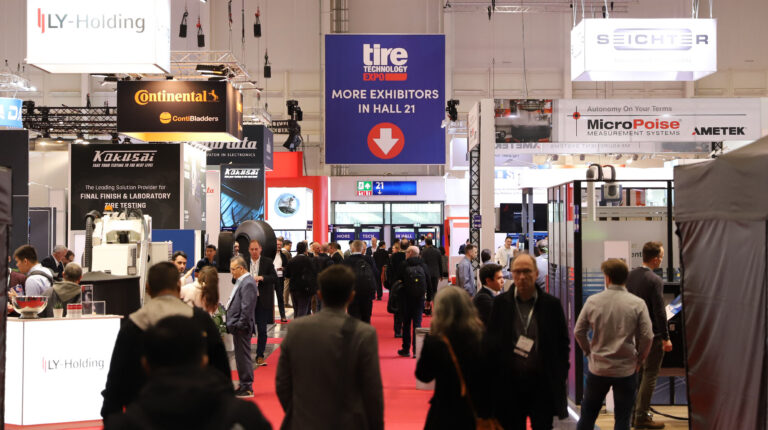
Tire Technology Expo 2026, held on March 3-5 in Hannover, Germany, cemented its reputation as the leading global event for tire design, development and manufacturing. The three-day show brought together top industry players, suppliers and researchers to discuss the latest technological advances and regulatory challenges shaping the future of the tire industry. From groundbreaking product launches on the show floor to thought-provoking conference discussions about the most important and complex issues affecting the tire industry, the expo reflected the sector’s push toward sustainability, efficiency and digitalization.
Exhibition highlights
The exhibition floor featured innovation and high-performance solutions from all 240+ exhibitors.
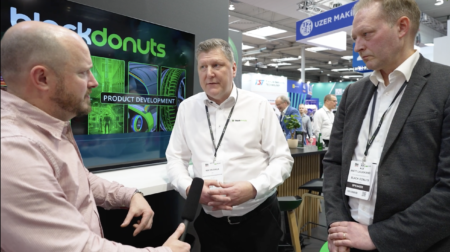
Black Donuts presented turnkey factory solutions that combine digital twin technology with bio-based material innovation. Its integrated system connects tire design, digital factory simulation and manufacturing in one workflow, supporting faster commissioning, smarter factory footprints and measurable sustainability gains. The approach links compound formulation and material testing with production optimization before manufacturing begins. “We are exhibiting to engage directly with manufacturers and show how one integrated, validated engineering ecosystem connects factory engineering, tire and material R&D and digital tools to deliver measurable factory and product improvements while reducing risk through a single connected partner,” said Tomi Pekkola, the company’s vice president of sales and marketing.
Kokusai showcased its advanced indoor wear testing concept developed in response to Euro 7 and ISO DIS 18512-2 requirements. The system uses a structured load case model and micro-concavity approach to deliver consistent wear rates and improved reproducibility across multiple cycles. Combining precise hardware control with accurate force and moment management, the solution simplifies the transformation of outdoor data into indoor test parameters, and supports reliable compliance for OEMs and laboratories. “This event is the best place to showcase our solutions and communicate that we are currently commissioning a new tire abrasion testing system at our Application Center in Tokyo, to demonstrate significantly improved reproducibility while shortening overall testing time,” explained Markus Winter, director of marketing and sales.
Ecopower demonstrated its latest advances in sulfur-containing silane coupling agents, silane polymers and functional resins, designed to enhance tire performance and sustainability. The company’s new generation of silane coupling agents provides superior filler-polymer interaction, improving abrasion resistance, wet grip and durability while reducing rolling resistance and heat build-up. Sales manager Faye Lin said, “We are exhibiting at Tire Technology Expo to meet global tire and rubber manufacturers and introduce our latest silane and resin solutions that improve performance and process efficiency.”
Visitors at the UP-Labels booth were greeted with live demonstrations of the UP-Tireworks application process. The company’s latest development enables tire manufacturers to apply custom micro-decals featuring logos, safety icons or product-specific data directly to the tire sidewall. The micro-decals are applied during the final finishing stage of production and are compatible with semi- and fully automated processes. They are exceptionally thin, delivering a discreet ‘no-label’ look that blends with the tire sidewall. “Tire Technology Expo is our premier stage to showcase innovation, spark new business and deepen existing partnerships through high-level industry dialog,” said the company’s CEO, Gerald Ullrich.
Conference insights
Tire Technology Expo Conference delivered deep industry insights, featuring expert-led discussions on regulatory challenges, sustainability strategies and emerging technologies.
As in previous years, circularity and sustainability were key topics. Sustainability has long had a complicated relationship with heavy manufacturing, which is shaped by scale, cost pressures and the technical demands of industrial production. While scientists and engineers strive to decarbonize complex processes, greenwashing has crept into industry rhetoric, eroding trust in genuinely sustainable solutions. In tire manufacturing, however, recovered carbon black (rCB) stands apart from this rhetoric.
“rCB is not carbon black; it is a new type of material,” stated Prof. Jorge Lacayo-Pineda, head expert in materials evaluation at Continental Tires, during his presentation, ‘Identification of rCB in cured rubber compounds’. Prof. Lacayo-Pineda emphasized the critical importance of transparency in the industry, noting that without it, achieving true circularity would be impossible.
Bridgestone EMIA’s head of end-of-life tire and circular economy, Marco Musaio, and Bridgestone Americas’ principal applied researcher for sustainability and circular economy, Marcela Castaño, spoke about the company’s journey toward a circular business model. As part of this long-term commitment, it is innovating and co-creating the precise technologies, processes and systems that will ultimately enable the transition.
Castaño, who spoke with TTI after the presentation, said, “In our journey to sustainability, we are highlighting the long-term vision and what we are doing to enable that ecosystem development. But we are also thinking on short-term solutions and tools that will enable us to do that.”
Musaio added, “Each market might have its peculiarity, which requires an ecosystem with a different pathway. Of course, there is knowledge sharing among projects, but nevertheless, there is a uniqueness that we need to tackle at regional level.”
Regional challenges, including regulations such as Euro 7, remain high on the industry agenda. Adam McCarthy, secretary general of Tyres Europe, was unable to travel to the show due to flight restrictions but addressed the conference via video. He provided updates on how EU regulations – from Euro 7 to ESPR and the upcoming Circular Economy Act – are reshaping tire design, and gave a breakdown of last year’s “tsunami of regulations,” as he described it. He also highlighted how policy drives innovation, shapes material choices and challenges the industry to balance sustainability with safety, quality and competitiveness in a rapidly evolving landscape.
With sustainability regulations restricting materials, plus geopolitical unrest and growing uncertainty around material availability and prices, simulation has become an essential tool in the development of new tire technologies. Beyond new compound development, simulation has played, and will continue to play, a key role in tire performance development.
Cecilia Malverti, material testing innovation engineer at Pirelli, and Filippo Bassetto, tire modeling team leader and R&D at Pirelli, presented on the critical role of accurately characterizing rubber compound friction for predicting tire performance under diverse conditions. Their study measured friction using a high-speed linear friction tester (HSLFT) and validated the results through full-scale tire simulations, correlating them with experimental data. By integrating compound-level friction maps from HSLFT into advanced FEA-based tire models, the approach represents local friction behavior while maintaining global grip consistency. Comparative analyses revealed how sliding speed, pressure and thermal effects influence friction, showing strong alignment between virtual models and physical tests across controlled surfaces. This workflow enables robust grip characterization, supporting realistic tire models for simulations and driving simulators, and reducing reliance on costly outdoor testing while maintaining accuracy in performance prediction.
Conference director Tim Sandford said, “There was a strong sense of collaboration throughout the conference. With repeated calls for partnership in many presentations, the industry clearly came together, united in tackling challenges as one, which was great to see. Huge thanks to everyone for coming, and especially to our first-class group of speakers and their excellent contributions.”
Tire Technology International Awards for Innovation and Excellence
Returning for another year, the Tire Technology International Awards for Innovation and Excellence 2026 celebrated the sector’s most outstanding innovations and achievements over the past 12 months. Comprising 13 categories, the awards are not only a celebration of technological advances and progress toward a greener and more sustainable tire industry, but also a chance to acknowledge the personal achievements of some remarkable individuals. The winners of this year’s awards:
- Bridgestone was awarded Environmental Achievement of the Year – Tire Design for its TBR tire produced with 70% recycled and renewable content.
- Continental won the Environmental Achievement of the Year – Manufacturing award for its work in reducing freshwater use.
- Michelin was awarded Environmental Achievement of the Year – Industry Contribution for its BioButterfly project.
- Flexsys won the Chemicals and Compounding Innovation of the Year award for its alternative to 6ppd innovation
- Materials Innovation of the Year was given to Teijin Aramid for its Twaron Next technology.
- Goodyear and TNO were awarded R&D Breakthrough of the Year for their integration of tire intelligence with AEB systems.
- Comerio Ercole won Tire Manufacturing Innovation of the Year for its Zeus calendering line.
- Uzer Makina was named Tire Industry Supplier of the Year.
- Tire Concept of the Year was given to Michelin for its development of the Lunar Airless Wheel (MILAW).
- Michelin was also awarded Tire of the Year for its Primacy 5 Energy.
- For a fifth time since 2008, Continental won Tire Manufacturer of the Year.
Two further awards were given for individual achievements in the industry:
- Max Dixey, a PhD candidate at Queen Mary University, won the Young Scientist Prize for his presentation ‘Effects of carbon black activators on dynamic viscoelasticity’
- The Lifetime Achievement Award went to Michelin’s Pascal Prost – a veteran of the tire industry and a hugely experienced engineer and researcher.
“As is now becoming the norm, this year’s awards were incredibly close,” said Matt Ross, chairman of the awards and editor-in-chief of Tire Technology International. “Continental and Michelin have picked up multiple awards and should be highly commended, but I’m also happy to see such an array of winners across the whole range of categories. The level of innovation on display across the tire sector is staggering, and I hope that this year’s awards have captured even a hint of the groundbreaking work taking place to move this industry forward.”
Looking ahead
Tire Technology Expo 2026 emphasized innovation, sustainability and digitalization as critical pillars of the future of the tire industry. As tire manufacturers continue to embrace cutting-edge technologies, the industry’s drive toward efficiency and environmental responsibility is becoming more evident.
Next year’s show will take place in Hannover on March 2-4. Keep an eye on the website for further information