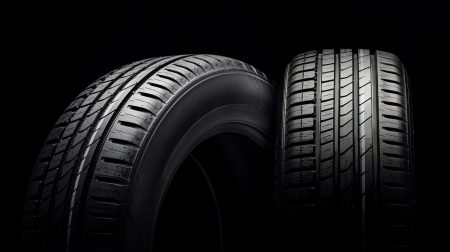


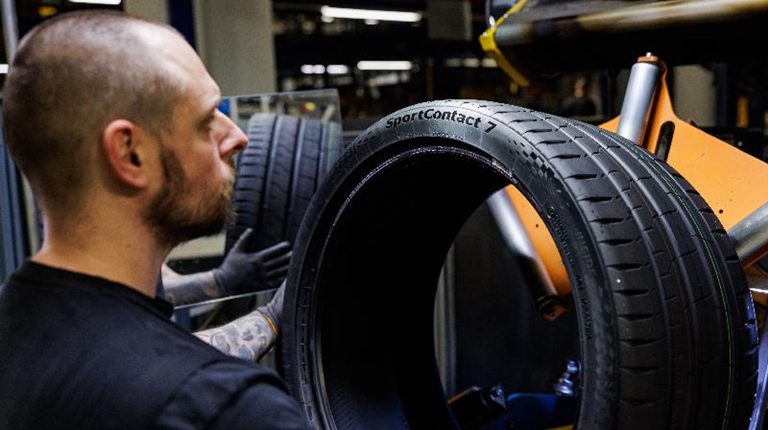
Continental has announced that by the end of 2027, it plans to add more than 650 new tire sizes across its product lines for the original equipment (OE) and replacement markets, responding to demand from larger, heavier and more powerful vehicles and electrified powertrains. Ultra-high-performance (UHP) tires are defined as tires measuring 18in and above.
“With our expanded UHP portfolio, we are responding directly to the increasing demands of modern vehicles,” said Edwin Goudswaard, head of research and development for Continental’s Tires group sector. “This enables us to offer our customers around the world even more tailored solutions for safety, efficiency and driving dynamics.”
Growing importance of high-performance tires
High-performance tires for passenger cars and light commercial vehicles have become an increasingly important part of Continental’s business. Between 2020 and 2025, their share of global passenger-car tire sales across all brands increased from 41% to 55%.
The trend toward larger tires reflects wider changes in the vehicle market. Vehicles are becoming larger, heavier and more powerful, and the growing popularity of SUVs and the additional weight of EV batteries are also contributing to increased vehicle mass. At the same time, modern electric drive systems can deliver torque levels previously associated with high-performance sports cars.
These trends are placing greater demands on tires, which must support heavier loads while maintaining safety, efficiency and comfort. Ultra-high-performance tires combine high grip, short braking distances and precise handling with low rolling resistance and high mileage. Continental develops UHP tires primarily for wheel-and-tire combinations of 18in and above, as well as performance SUVs, premium sedans, sports cars and high-performance EVs.
“As modern tires become larger, heavier and more powerful, tires are becoming even more critical. They are no longer simply the vehicle’s connection to the road but a key prerequisite for safety, efficiency and driving dynamics,” added Goudswaard. “The UHP segment clearly demonstrates how capable modern tires need to be. The art lies in combining conflicting requirements at the highest level, and that is precisely what sets our tires apart.”
Continental is expanding its UHP offering across all major markets and will introduce more than 650 new tire sizes for OE and the replacement business by the end of 2027. In addition to the core Continental brand, this includes secondary brands such as Semperit and Uniroyal.
Material expertise and intensive testing for maximum performance
UHP tires must meet a wide range of requirements, such as high grip on dry and wet roads, short braking distances and precise handling, while at the same time delivering low rolling resistance, high ride comfort and high mileage. The rubber compound plays a central role in achieving this balance, as it largely determines a tire’s performance profile and must balance multiple characteristics.
Continental uses digital simulations, laboratory analysis, bench testing and road testing across a range of temperatures, loads, speeds and conditions to develop UHP tires. Its High Performance Technology Center in Korbach, Germany, supports manufacturing-process development, with findings applied across its global production network, which produces UHP tires up to 24in. Testing is carried out at facilities including the Contidrom near Hanover, Arvidsjaur in Sweden and Uvalde in Texas, covering wet- and dry-road braking, handling, high-speed performance, comfort and durability.
Continental also draws development input from collaborations with tuning specialists such as ABT Sportsline and Brabus, as well as from motorsport. Through its Hoosier racing-tire subsidiary, the company applies motorsport experience to road-tire development, using insights into rubber compounds, tire construction and performance under extreme loads.
In related news, Continental launches the successor to its ContiMotion sport touring tire