

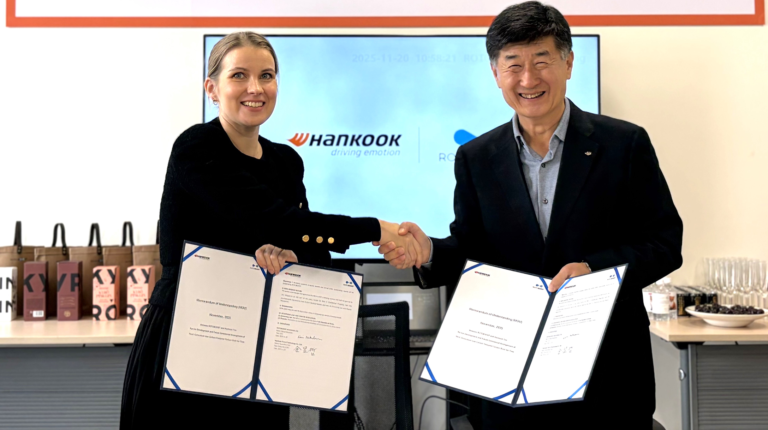
Hankook Tire & Technology has signed a memorandum of understanding with Rotoboost, a company specializing in thermocatalytic decomposition of methane gas, to jointly develop a low-carbon footprint carbon material for tire applications.
The companies are collaborating on technologies intended to reduce CO₂ emissions during the raw material acquisition phase, aligning with Hankook Tire’s long-term strategy to achieve net-zero greenhouse gas emissions by 2050.
Carbon black, a key material in tire production, is derived from fossil-based feedstocks and is associated with high CO₂ emissions. To address this, Hankook Tire has been conducting research into sustainable alternatives, including recycled carbon black and certified carbon black, aimed at reducing emissions during the tire manufacturing process.
The collaboration has focused on developing turquoise hydrogen-based carbon materials. This material is produced during the process of generating hydrogen by decomposing methane gas in a high-temperature reactor. As a circular material with lower CO₂ emissions, it has recently gained attention in industries such as automotive and tire manufacturing.
Through this collaboration, Hankook Tire will pursue joint objectives that include optimizing the material properties of turquoise hydrogen–based carbon material, validating its performance in tire composite materials and reducing greenhouse gas emission intensity by more than 50% without compromising product performance.
The company also plans to establish a quantitative verification framework based on life cycle assessment (LCA) and environmental product declaration (EPD) to transparently validate carbon-reduction effects across the entire lifecycle – from raw material sourcing to manufacturing.
In related news, Apollo Tyres and KIIT announce strategic academic collaboration